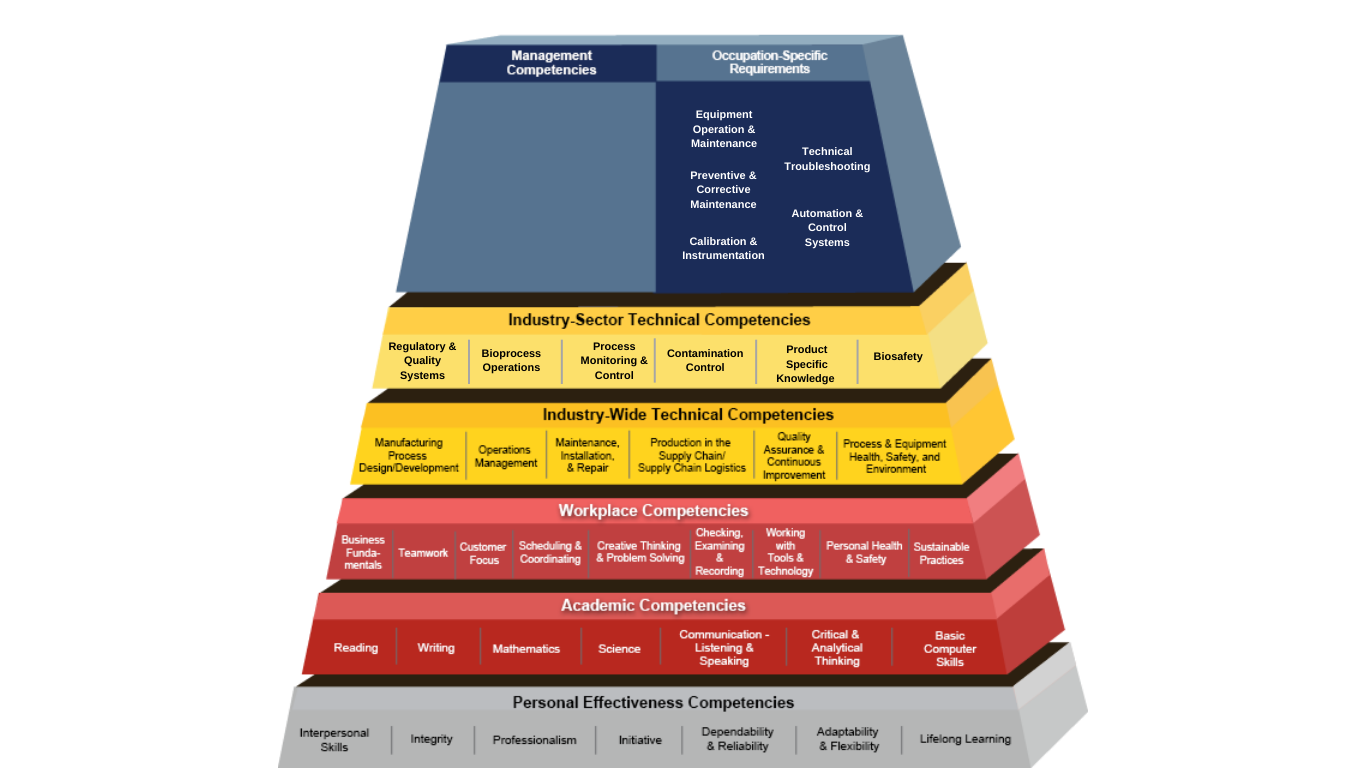
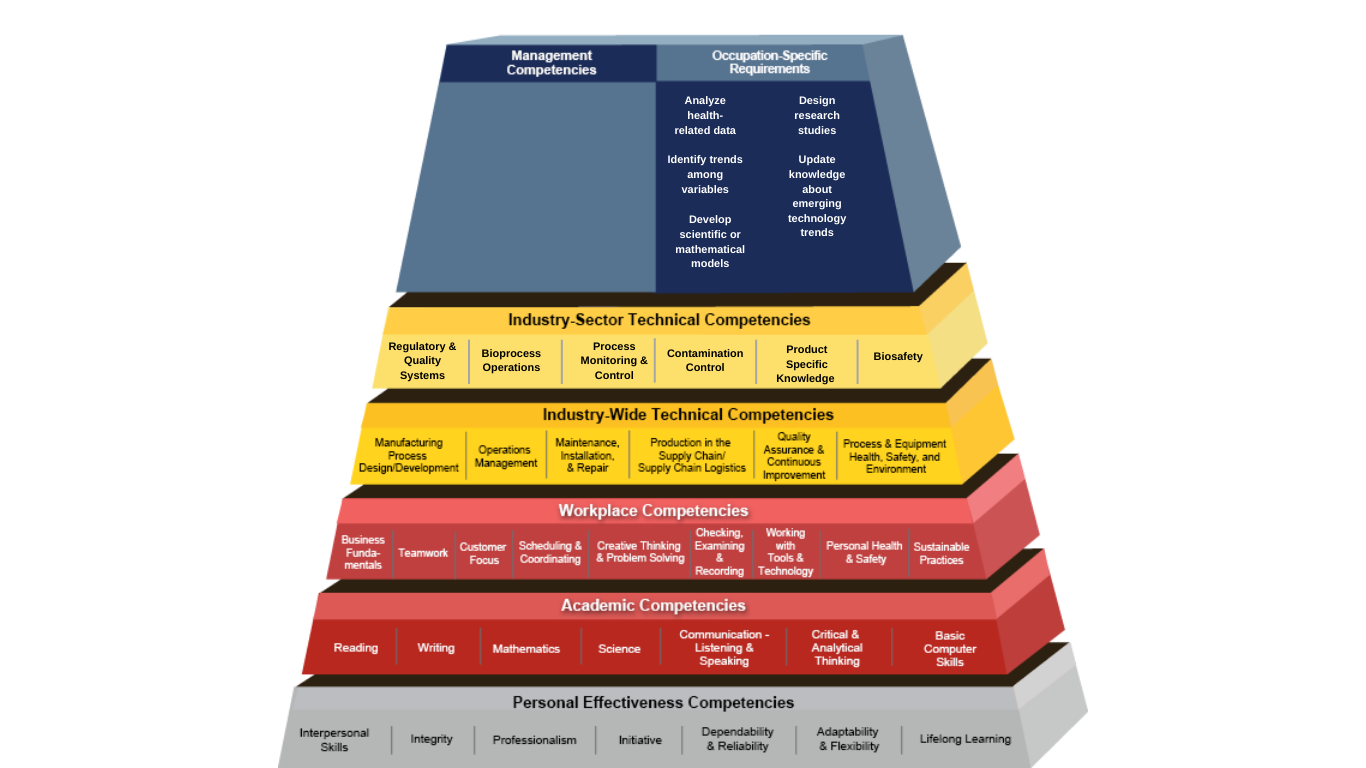
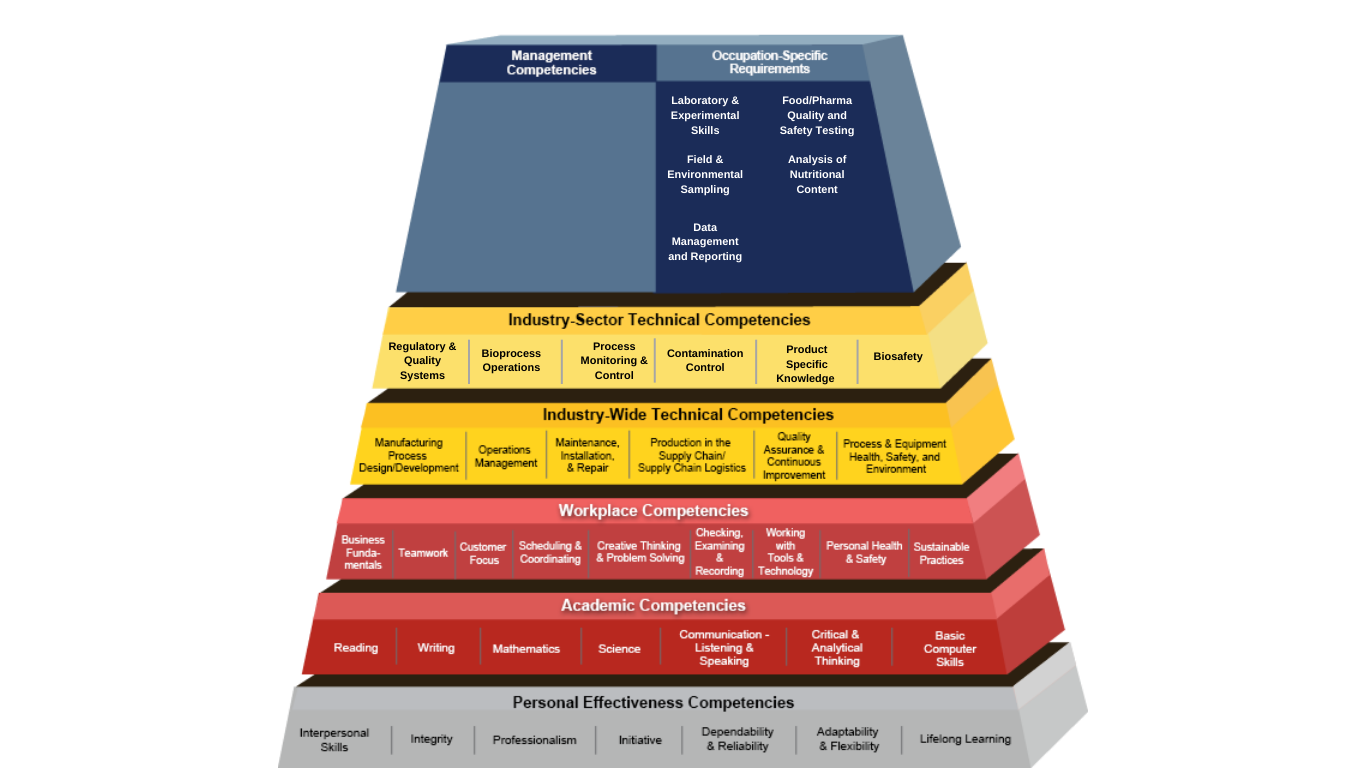
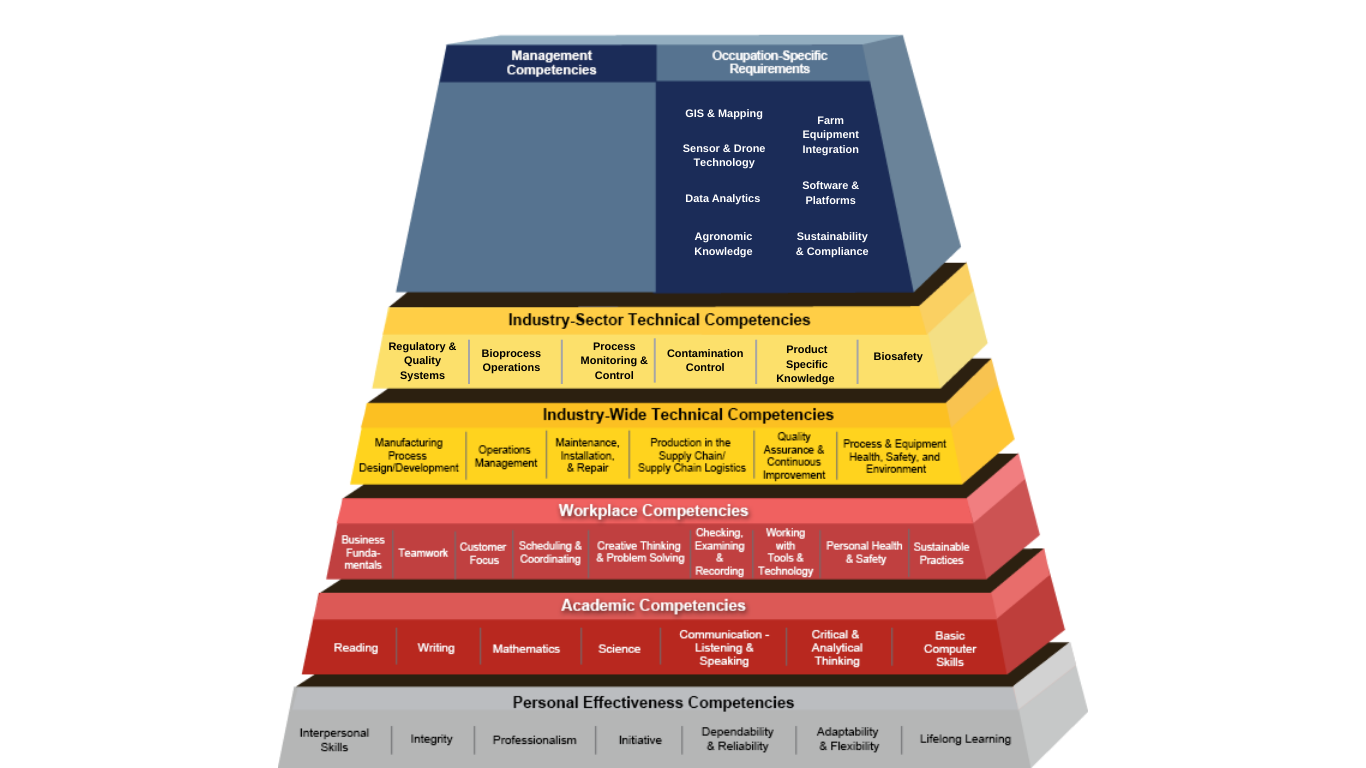
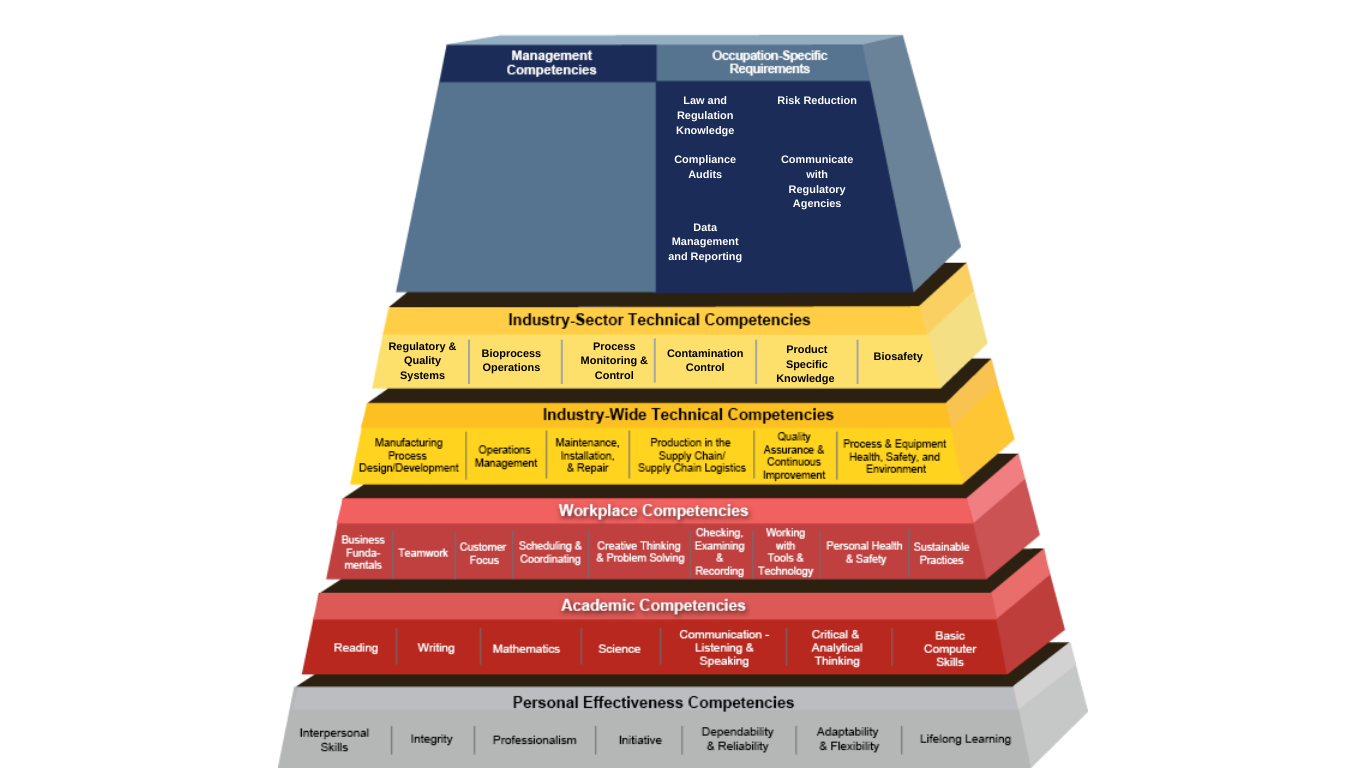
A biomanufacturing competency model serves as a foundational tool to define and support new and emerging occupations by outlining the knowledge, skills, and abilities required across various roles within the field.

Vision for this Model
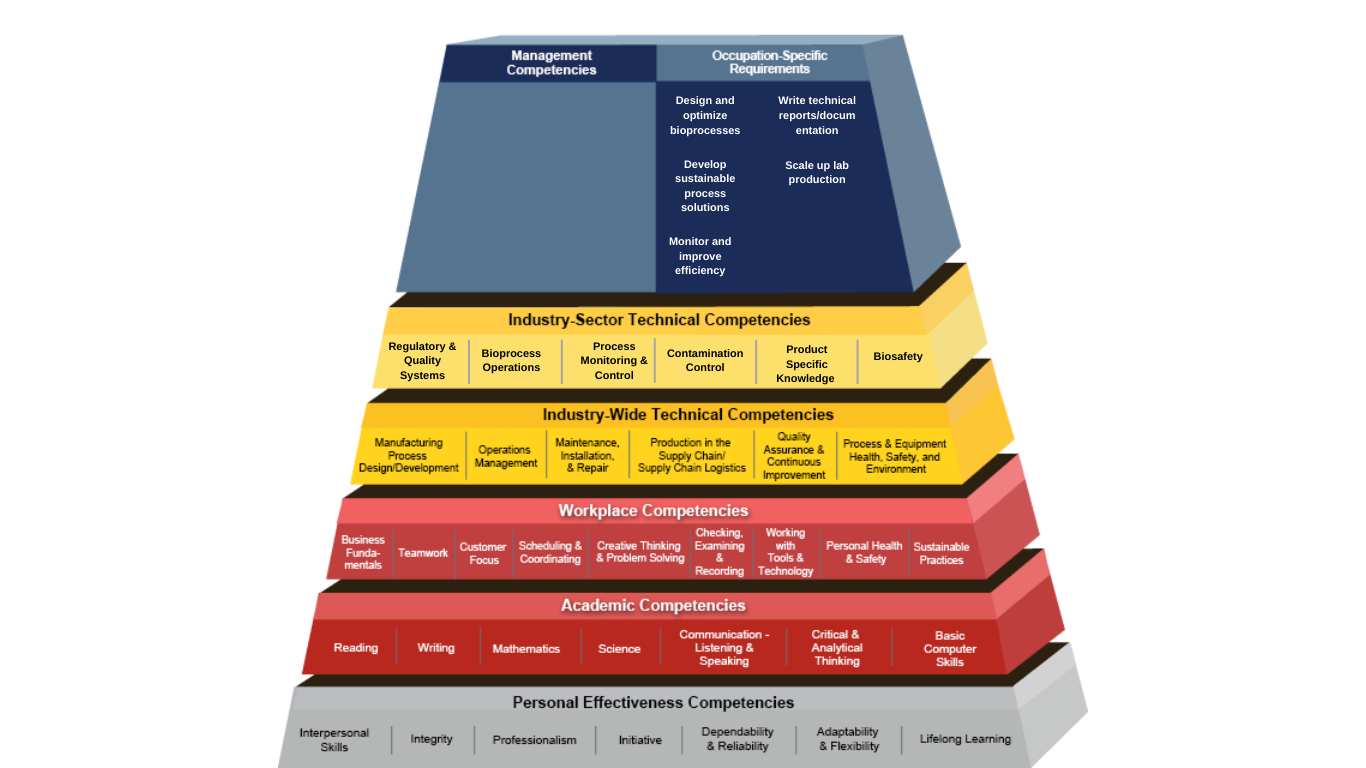
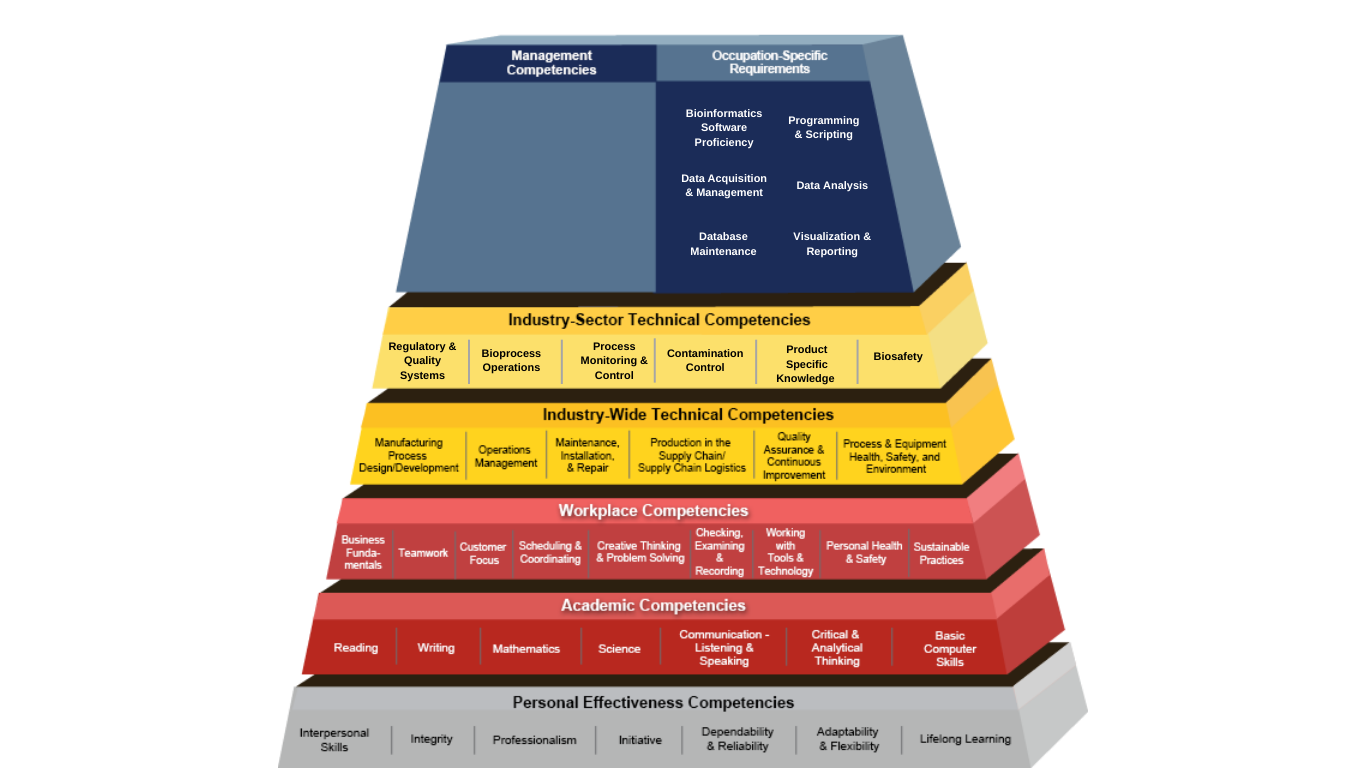
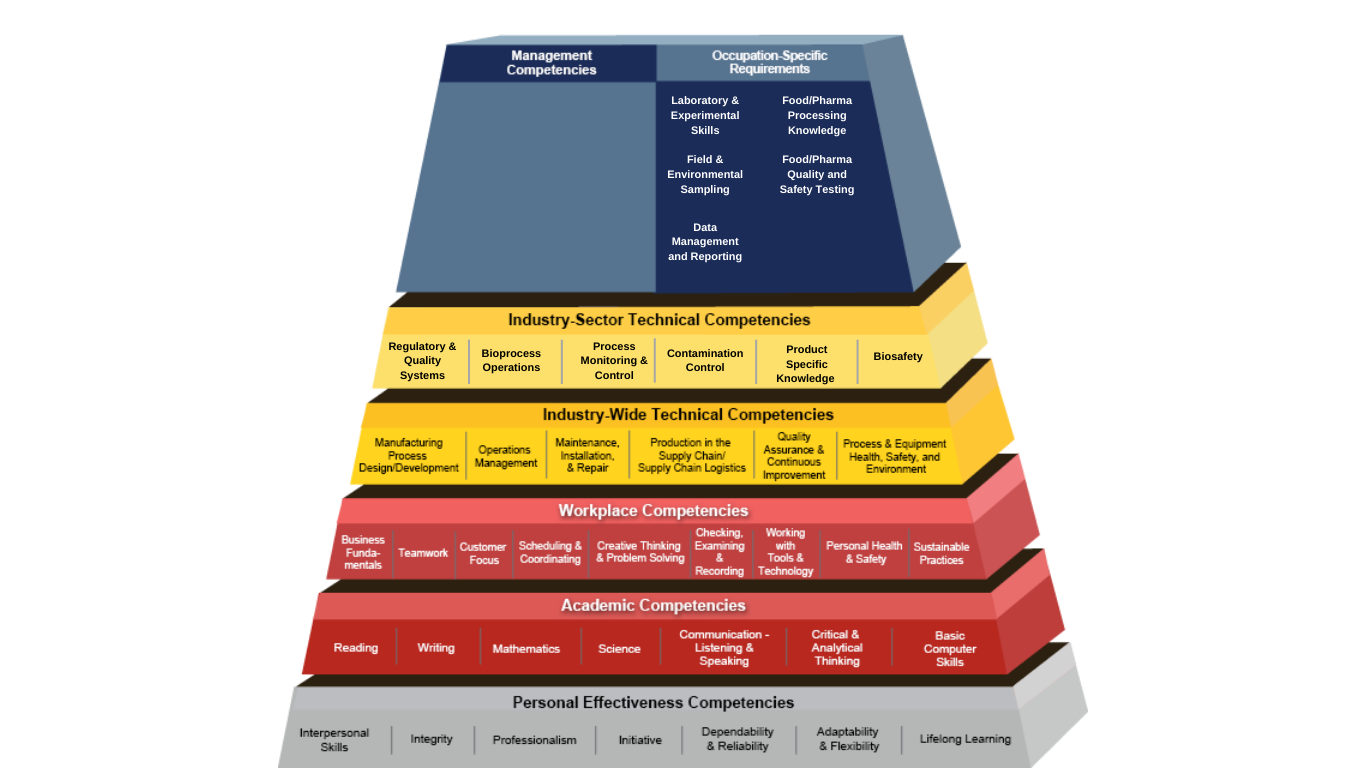
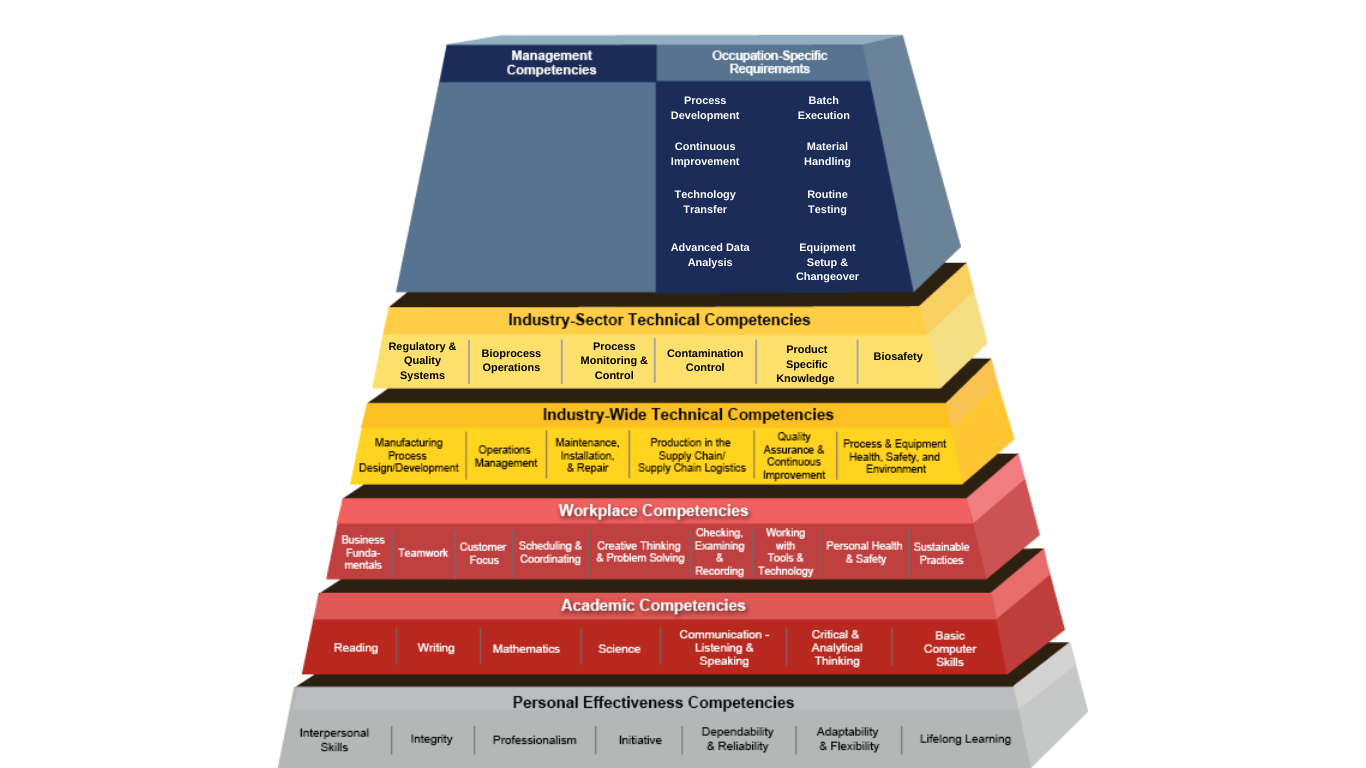
The foundation and vision for the biomanufacturing competency model are informed by the U.S. Department of Labor’s Employment and Training Administration (ETA) and its Competency Model Clearinghouse Authoring Guide, titled “Understanding and Writing Nationwide Competency Model Frameworks.” This nationally recognized framework provides a structured, tiered approach to identifying foundational, industry-wide, and occupation-specific competencies, and serves as the guiding methodology for the development of this model.
Source: Competency Model Clearinghouse Authoring Guide – ETA, U.S. DOL
Foundational
Competencies
Foundational competencies include generalized competencies (including soft skills, academic skills, and some workforce readiness skills) that the Employment and Training Administration (ETA) has found to be fundamental to success throughout the workforce and that serve as the basis for all of the competency models in the Competency Model Clearinghouse.
Industry
Competencies
Industry competencies apply to many jobs, occupations, or work roles within a specific industry or industry subsegment or subsegments; or profession and optional professional specialization or specializations. These competencies also promote transferability of skills across occupations within the same sector.
Occupational
Competencies
Occupational-specific competencies are the knowledge, skills, and abilities required to perform the tasks and functions unique to a particular job or occupation. These are often task-oriented and technical in nature, reflecting what an individual must do on the job to perform effectively in a specific role (e.g., CNC Machine Operator, Bioprocess Technician, Quality Control Analyst).
Foundational Competencies
These are essential cross-cutting competencies that apply to all occupations in the Top 10 Bio list. They ensure individuals are prepared for success in academic, technical, and professional environments.
Personal Effectiveness
- Reliability & Integrity: Demonstrates ethical behavior, accountability, and trustworthiness.
- Adaptability & Flexibility: Adjusts to new challenges, technologies, and work settings in a rapidly evolving industry.
- Self-Initiative & Lifelong Learning: Willingness to continually learn and take responsibility for personal development.
Academic Competencies
- Mathematics and Statistics: Understanding of algebra, measurement systems, and data interpretation.
- Reading and Writing: Ability to comprehend complex scientific texts and produce accurate technical documentation.
- Science Literacy: Fundamental knowledge in biology, chemistry, and physics to understand bioprocesses.
Workplace Readiness Competencies
- Teamwork & Collaboration: Works effectively in interdisciplinary teams.
- Communication: Communicates technical information clearly to diverse audiences.
- Digital Fluency: Proficient in using digital tools, databases, and data visualization platforms.
- Problem-Solving and Critical Thinking: Applies logic and analysis to address technical and operational challenges.
Industry-Specific Competencies
This framework reflects core competencies required across all roles within agricultural biomanufacturing, regardless of specialization.
Biomanufacturing Systems Knowledge
- Understanding of Biological Production Systems: Knowledge of fermentation, cell culture, upstream/downstream processes.
- Systems Thinking: Ability to see interrelationships among equipment, processes, and quality outcomes.
Safety, Health, and Environmental Awareness
- Biosafety and Biosecurity Practices: Understanding containment levels, pathogen handling, and security protocols.
- Regulatory Compliance: Familiarity with OSHA, EPA, FDA, and USDA regulations relevant to bio-based manufacturing.
- Sustainability Principles: Awareness of green chemistry, waste management, and lifecycle impacts.
Technical Literacy
- Process Monitoring and Control: Use of sensors, SCADA, or PLC systems for process control.
- Instrumentation and Measurement: Proficiency in using lab equipment and bioprocess instrumentation.
- Data Acquisition and Analysis: Competence in data logging, quality control, and trend analysis.

1. Regulatory & Quality Systems Knowledge
- Good Manufacturing Practices (GMP) – Understanding and applying GMP principles in all operations.
- Good Documentation Practices (GDP) – Writing and maintaining batch records, SOPs, and logs according to regulatory standards.
- Compliance with Regulatory Agencies – Familiarity with FDA, EMA, or other governing bodies relevant to biologics manufacturing.
- Validation & Qualification – Participating in process, equipment, and method validation activities.
2. Bioprocessing Operations
- Upstream Processing
- Preparation and sterilization of media and buffers.
- Inoculation, operation, and monitoring of bioreactors/fermenters.
- Managing cell culture or microbial fermentation at scale.
- Downstream Processing
- Harvesting cells or products.
- Filtration (microfiltration, ultrafiltration) and centrifugation.
- Purification methods like chromatography and precipitation.
3. Process Monitoring & Control
- Critical Process Parameters (CPPs) – Identifying and controlling variables that affect product quality (e.g., temperature, pH, oxygen levels).
- Statistical Process Control (SPC) – Using data to monitor process performance and detect trends or deviations.
- Automated Systems – Operating and troubleshooting distributed control systems (DCS) and programmable logic controllers (PLCs).
4. Contamination Control
- Aseptic Processing – Techniques for preventing contamination in cleanrooms and biosafety areas.
- Environmental Monitoring – Sampling air, surfaces, and water to ensure sterile manufacturing environments.
- Gowning Procedures – Following correct donning/doffing protocols for different cleanroom classifications.
5. Product-Specific Knowledge
- Biologics Production – Understanding proteins, monoclonal antibodies, vaccines, cell-based products, or enzymes.
- Stability & Shelf-Life Testing – Assessing product integrity over time.
- Specialized Equipment – Experience with tangential flow filtration (TFF), lyophilization, or single-use systems.
6. Safety & Risk Management
- Biosafety Levels (BSL-1, BSL-2, BSL-3) – Understanding and adhering to protocols based on organism risk.
- Hazardous Material Handling – Safe use and disposal of chemicals, solvents, and biological waste.
- Emergency Response – Procedures for spills, contamination events, or equipment failures.
Occupation-Specific Competencies
1. Agricultural & Food Scientist
- Design and conduct experiments to improve agricultural output.
- Analyze nutritional content and ensure compliance with food safety standards.
- Collaborate with biotechnologists to apply innovations in crop or livestock development.
2. Biological/Food Science Technician
- Prepare specimens and run biological assays.
- Maintain laboratory records and assist with data collection/analysis.
- Operate laboratory equipment in accordance with safety protocols.
3. Biomanufacturing Specialist / Process Technician
- Execute and monitor bioprocess production runs.
- Maintain aseptic conditions and troubleshoot equipment malfunctions.
- Follow SOPs and GMP documentation practices.
4. Regulatory Affairs Specialist (Bioprocess)
- Compile and submit documentation for regulatory approval.
- Interpret federal and international regulations.
- Conduct internal audits and ensure record-keeping accuracy.
5. Biostatistician / Data Analyst in AgBio
- Apply statistical models to biological datasets.
- Interpret results from field trials or gene expression studies.
- Visualize data using software like R, Python, or SAS.
6. Agricultural Process Engineer (Biofuel, Enzymes)
- Design and optimize biocatalytic and fermentation processes.
- Scale-up production from bench to pilot plant.
- Assess energy efficiency and process yields.
7. Environmental / Agricultural Robotics Technician
- Install and maintain autonomous agricultural machinery.
- Integrate sensor networks with AI systems.
- Diagnose and repair mechanical and electronic faults.
8. Precision Ag Specialist/ Digital Agriculture
- Utilize GIS, remote sensing, and data analytics to optimize farming operations.
- Configure variable rate technology (VRT) systems.
- Interpret drone and satellite imagery for field-level insights.
9. Bioinformatics Lab Technician
- Handle samples in BSL-2/3 labs following biosafety standards.
- Identify and isolate pathogens using PCR and ELISA methods.
- Implement disinfection protocols and maintain secure lab environments.
10. Bioprocess Equipment Maintenance Technician
- Conduct preventive maintenance on bioreactors, pumps, and valves.
- Calibrate instruments and sensors to ensure process accuracy.
- Document work in maintenance logs and follow safety lockout/tagout procedures.
Using the Model
Employers can use competency models as strategic tools to define job roles, guide hiring, and support workforce development. By clearly outlining the knowledge, skills, and behaviors required for specific positions, competency models help create accurate job descriptions, effective interview processes, and targeted performance evaluations. They also inform training and onboarding programs by aligning learning objectives with real workplace needs, ensuring employees are equipped to perform effectively. Additionally, competency models support career advancement by mapping out clear pathways for growth and promotion. When shared with educational and workforce partners, they help align curriculum and training programs with industry standards, improving the quality and readiness of incoming talent. Ultimately, competency models enable employers to build a skilled, future-ready workforce through structured and consistent talent practices.
Competency Matrices
| Title | Link |
|---|---|
| Agricultural Process Engineer Competency Matrix | Download |
| Agriculture & Food Scientist Competency Matrix | Download |
| Bioinformatics Technician Competency Matrix | Download |
| Biological Food Science Technician Competency Matrix | Download |
| Biomanufacturing Competency Matrix | Download |
| Bioprocess Equipment Maintenance Technician Competency Matrix | Download |
| Biostatistician Competency Matrix | Download |
| Environmental / Agricultural Robotics Technician Competency Matrix | Download |
| Precision Agriculture Competency Matrix | Download |
| Regulatory Affairs Specialist Competency Matrix | Download |
Competency Models
| Title | Link |
|---|---|
| Agricultural Process Engineer Competency Model | Download |
| Bioinformatics Competency Model | Download |
| Biological Food Science Technician Competency Model | Download |
| Biomanufacturing Process Technician Competency Model | Download |
| Bioprocess Maintenance Technician Competency Model | Download |
| Biostatistician Competency Model | Download |
| Food Scientist Competency Model | Download |
| Precision Agriculture Competency Model | Download |
| Regulatory Affairs Specialist Competency Model | Download |
| Robotics Technician Competency Model | Download |
Education & Credentials
Micro-Credentials & Certificates: Stepping-Stones Into Biomanufacturing
Not every career path begins with a four-year degree. In biomanufacturing, micro-credentials and short certificates provide a fast, low-risk way to step into the industry, build confidence, and test whether the field is the right fit. These targeted, skills-based credentials can often be earned in weeks or months—not years—making them an ideal starting point for people exploring career options.
For entry-level jobseekers, micro-credentials in areas like Good Manufacturing Practices (GMP), aseptic technique, OSHA safety, or data literacy serve two important purposes:
- A Trial Run: They let the jobseeker experience the work environment, assess their interest, and understand industry expectations without committing to a long degree program.
- A Building Block: Each credential becomes a verified stepping-stone that stacks toward more advanced certificates, apprenticeships, or degrees. Employers recognize these achievements, often rewarding them with higher pay or expanded responsibilities.
Because biomanufacturing is an emerging, fast-growing industry, employers are eager to see candidates who show initiative through stackable, industry-recognized credentials. Even a single micro-credential signals readiness, while a sequence of certificates creates a visible career ladder that can take someone from entry-level technician to specialist, supervisor, or even advanced professional roles.
In short: micro-credentials and certificates are not just resumé boosters—they’re on-ramps to opportunity, helping people get started, move up, and stay mobile in a high-growth industry.
Micro-credentials & Certificates
Short, stackable credentials help you break in and move up fast. Popular options include GMP/GLP, Aseptic Technique, OSHA‑10, Quality systems, Data literacy, PLC basics, Instrumentation, GIS fundamentals, and Six Sigma—each adding proof of skill for promotions. See example below.
| Biomanufacturing Specialist / Process Technician | Biological Technician | Biosecurity / Bioinformation Lab Technician | Bioprocess Equipment Maintenance Technician | Regulatory Affairs Specialist (Bioprocessing) | Biostatistician / Data Analyst (AgBio) | Process Engineer (Biofuels/Enzymes) | Environmental/Agricultural Robotics Technician | Digital Agriculture / Precision Ag Specialist | Agricultural & Food Scientist | |
| GMP/GLP Compliance | ✓✓✓ | ✓✓ | ✓✓ | ✓✓ | ✓✓✓ | ✓ | ✓✓✓ | ✓ | ✓ | ✓✓ |
| Safety & Biosafety | ✓✓✓ | ✓✓✓ | ✓✓✓ | ✓✓ | ✓✓ | ✓ | ✓✓ | ✓✓ | ✓✓ | ✓✓ |
| Aseptic / Sterile Technique | ✓✓✓ | ✓✓ | ✓✓ | ✓ | ✓ | ✓✓ | ✓ | ✓✓ | ||
| Troubleshooting & Maintenance | ✓✓ | ✓ | ✓ | ✓✓✓ | ✓ | ✓ | ✓✓✓ | ✓✓✓ | ✓✓ | ✓✓ |
| Data Literacy & Documentation | ✓✓✓ | ✓✓ | ✓✓✓ | ✓✓ | ✓✓✓ | ✓✓✓ | ✓✓✓ | ✓✓ | ✓✓✓ | ✓✓✓ |